When to send it, what to put in it, and 11 messages you can copy for the situations that actually come up: the event, the coffee, the investor, the recruiter, the stand. Written for British inboxes.
Follow up within one or two days, while they can still place you. Open with where you met, mention one specific thing they said, and ask for something small or nothing at all. Then come back on the date they gave you. Keep it short enough to read on a phone. That is the whole method; below is the detail, and 11 messages to copy for the situations that come up most.
When
Within one or two days. Then on the date they named, if they named one.
What
Where you met, one specific thing they said, and a small ask or none.
How long
Three to five sentences. Short enough to read on a phone without scrolling.
When to stop
After two unanswered messages, unless their date arrives.
By Kai, Founder of Cardr. Updated . There are no statistics on this page: the follow-up rates usually quoted could not be traced to a published study when we looked in September 2026, so none is repeated here.
When to follow up
The day after,their date,and once more.
Timing is three moments, not one rule. The one that matters most is the date they gave you themselves, and it is the one almost nobody keeps.
Day 0Write the noteWho, where, what they need, when to come back, what you promised. Before the next conversation.
Day 1 or 2First messageThey can still place you. Three to five sentences and one specific detail.
Their dateThe one that mattersThe moment they named. Almost nobody comes back on it.
3 to 4 weeksOnce more, if silentOnly with something new in it. Then stop.
LaterOnly with a reasonNews, an introduction, their date arriving. Never a bump.
The schedule we recommend, not measured data. Each stop has its reason under it; none has a reply rate, because there is no honest one to give.
Within a day or two they can still place you, so a short message reads as the rest of the conversation. After about a week it reads as an introduction. The detail, stop by stop, is in when to follow up after meeting someone.
Day 0 decides the rest. Write one sentence before you walk away: who they are, where you met, what they need, when to come back and what you promised. It is the raw material for every message below, and how to remember people you meet covers what to put in it.
And leave with their details, not only them with yours. A card handed over is a hope; their email in your phone is a follow-up you can actually send. That is the case for a QR code business card that opens a page they can send their own details back from, rather than one that only hands yours over.
What to say
Five parts,in this order.
Every template below is built the same way. Once you can see the parts, you can write your own in the time it takes to find a template.
The five parts of a follow-up that gets answered, in the order they go
Write
Not
Their first name
“Hi Priya,”
“Dear Ms Shah,” unless that is how they spoke to you
Where you met
“Good to meet you at the chamber breakfast on Tuesday.”
“I hope this finds you well.”
One thing they said
“You said the November tender is the one that matters.”
“I enjoyed our chat about your business.”
A small ask, or none
“Would a short call next week help?”
A calendar link, or a request for an hour of their time
A plain sign-off
“Best,” then your name and one way to reach you
A signature with six links and a legal notice
The third row is the only one a template cannot write for you. It comes from the sentence you wrote down at the event. Priya is an invented example.
Where to send it
Email, LinkedIn,or a message.
Use the channel they gave you. Read down until a line is you, then stop.
They gave you a card or an email addressEmailThe default, and the right one for anything with a date, a document or a next step in it.
They said “just WhatsApp me”WhatsAppThat is an invitation, so use it. Cut the message to two lines and drop the subject.
You only have their name and companyLinkedInA connection request with one line about the conversation. Weak for anything with an attachment or a date.
Their mobile is on a card, and nothing was said about itEmail, not a textA number printed on a card is not an invitation to message it. If in doubt, email.
They asked you to ringPhone, then emailRing, then send two lines afterwards so what you agreed is in writing.
11 templates
Messages to copy,by situation.
Each is short enough to read on a phone. The words in square brackets are yours to fill in, and the note under each one says which line matters most.
01The morning after an event
Email
SubjectFollowing up from [event]
Hi [first name],

Good to meet you at [event] last night. I've been thinking about what you said about [the problem they described, in their words].

[One useful line: a thought, a name or a link that helps with it.]

If a quick call in the next couple of weeks would help, I'm happy to find a time. No worries if not.

Best,
[Your name]
Make it yours. The problem, in their words. If you cannot remember what it was, a template will not rescue the message, so spend the time on someone you can.
02After a coffee
Email
SubjectThanks for the coffee
Hi [first name],

Thanks for the coffee this morning, and for being so open about [what they told you].

As promised, here's [the article, contact or example I mentioned]: [link]. The part that fits your situation is [one line].

Let's do it again once [their timing, such as the move is done]. The next one's on me.

Best,
[Your name]
Make it yours. Send the thing you promised, the same day. Keep the last line only if they paid.
03An investor you met at an event
Email
Subject[Company]: following up from [event]
Hi [first name],
Good to meet you at [event]. You asked [the question they asked], and I didn't give you a proper answer, so here it is: [two lines, with one real figure from your own business].
Since we spoke, [one piece of progress that is true and checkable].
If it's useful, I can send the deck, or we could find 20 minutes in the next fortnight. Happy either way.
Best,
[Your name][Company], [what it does, in one line]
Make it yours. Answer the question they actually asked. Offer the deck rather than attaching it; a deck nobody asked for goes unread.
04A recruiter, when you are the candidate
Email
Subject[Role]: following up from [event]
Hi [first name],
Thanks for your time at [event] on [day]. You mentioned [the role] at [the company, or one of your clients], and it sounds close to what I'm looking for: [one line on why].
I've attached my CV as you suggested. The part most relevant to what you described is [one line].
Would a short call next week be useful? I'm free [two or three specific times].
Best,
[Your name][Mobile]
Make it yours. Give two or three real times, so they can reply in one line. Attach the CV only if they asked for it; otherwise offer it.
05Someone who stopped at your stand
Email
SubjectYour question at the [company] stand
Hi [first name],
Thanks for stopping at our stand at [show] on [day]. You were asking about [their question, such as lead times for a larger order].
[The answer, or the thing you promised to find out.]
If it would help, I can [one small next step: send a sample, price it up, call on Thursday]. Just reply to this and I'll sort it.
Best,
[Your name][Company]
Make it yours. Write to the question they asked, not to your brochure. They saw a lot of stands that day, and their own question is how they will place yours.
06A speaker whose talk you heard
LinkedIn
Hi [first name], I was in the room for your [talk] at [event]. Your point about [one thing they said] changed how I think about [your own work]. I would be glad to stay in touch.
Make it yours. Ask for nothing. A speaker hears from a lot of people after a talk, and the specific point is what makes yours one they read.
07After you pitched to a client
Email
Subject[Project]: the points from [day]
Hi [first name],

Thank you for the time on [day], and to [colleague] for joining.

The thing you pressed hardest on was [their main concern]. [One or two lines on how you would handle it, or where the proposal covers it.]

I've also looked into [the question you could not answer in the room]: [the answer].

I'll call on [day] as we agreed. If anything comes up before then, reply here and I'll pick it up.

Best,
[Your name]
Make it yours. Lead with their concern, not a summary of your pitch. The question you could not answer in the room, answered, is the best evidence you were listening.
08Someone you were introduced to
Email
SubjectRe: [the subject of the introduction email]
Thanks, [introducer's first name] (moving you to bcc to spare your inbox).

Hi [first name],

Good to meet you, over email at least. [Introducer] mentioned you're [their situation, such as looking for a part-time finance lead].

[One line on why you might be useful to them, or the one question you would like to ask.]

Would a 20-minute call in the next week or two work? I'm fairly free on [days].

Best,
[Your name]
Make it yours. Reply to the introduction within a day, and move the introducer to bcc in your first line. They can see you picked it up without being copied on the diary back and forth.
09Thanking whoever introduced you
WhatsApp or text
Hi [first name], thank you for putting me in touch with [name]. We're speaking on [day]. I'll let you know how it goes.
Make it yours. Then tell them how it went. Closing the loop is what gets you the next introduction.
10On the date they gave you
Email
Subject[Their timing], as you suggested
Hi [first name],

When we met at [event] in [month], you said to get back in touch [after the year end, or once the new hire started] about [what they needed].

That time has come round, so here I am. Is it still on your list?

If the timing has moved, tell me when suits better and I'll come back then.

Best,
[Your name]
Make it yours. This one only works if you wrote the date down on the day. Write the month, not "next month", which means nothing by the time it arrives.
11When they have not replied
Email
SubjectRe: [your first subject line]
Hi [first name],

I don't want to crowd your inbox, so this is the last I'll send on [the topic].

[One new thing: an article, a result or some news from their sector, and a line on why it made you think of them.]

If later in the year suits better, just say and I'll come back then.

Best,
[Your name]
Make it yours. Send it three to four weeks after the first, and only with something new in it. Then mean "last".
Or type who you met, where and what you talked about into the follow-up message generator, and get three drafts to start from: an email, a LinkedIn message and a text. Free, with no signup.
The line a template cannot write
Cardr Pro writesit from your note.
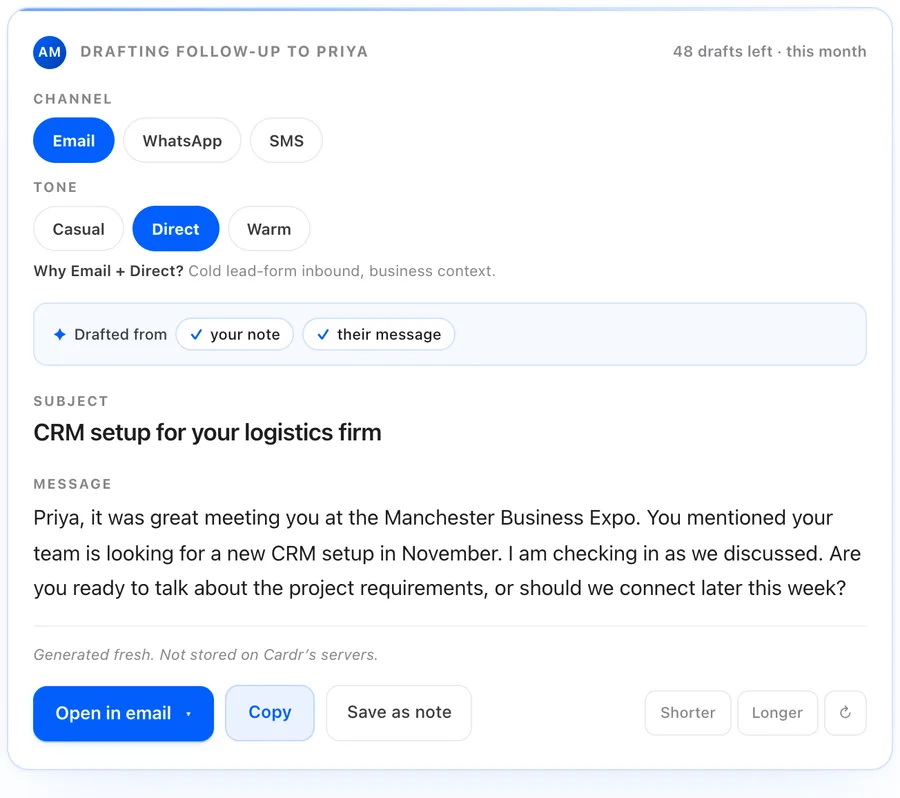
Every template on this page leans on the one bracket only you can fill: the thing they said. Cardr keeps that sentence against their name on the free plan. Pro drafts the whole message from it, by email, WhatsApp or text, and reminds you by email on the day your note named, or on the third day for anyone you have not got round to. You read it, change what you like, and send it yourself.
Try Pro free7 days free, with a reminder before the first charge. Your Cardr stays free either way.
A real draft from the running app, for a demo contact, on 22 September 2026. The line about the expo and the November project comes from the one sentence saved against her name.
Questions
Following up,answered.
How soon should you follow up after a networking event?
Within one or two days, while they can still place you. The next morning is usually best: it reads as considered rather than automatic, and you have had time to add the one specific detail. After about a week you are reintroducing yourself rather than following up, which is a harder message to write and an easier one to ignore.
What should a follow-up message after networking say?
Where you met, one specific thing they said, and a small ask or none, in three to five sentences under their first name. The specific thing is the only line that proves the message is not a mailshot, and it is the one line no template can write for you.
Is it better to follow up by email or on LinkedIn?
Use whatever they gave you. Email is better for anything with a date, a document or a next step in it. LinkedIn suits someone you only have a name and a company for, or a speaker you heard but did not really speak to. If they told you to message them on WhatsApp, do that.
How many times should you follow up if they do not reply?
Twice in all: the first message within two days, and one more after three to four weeks with something new in it. Then stop. The exception is a date they gave you themselves, which is always a fair reason to write again.
Is it too late to follow up after two weeks?
No. Acknowledge the gap in half a line, then lead with the specific thing they told you, so the message still reads as the rest of a conversation. If they named a date that has not arrived yet, wait for it instead.
What if I cannot remember what we talked about?
Then do not send a template with the brackets filled vaguely: “I enjoyed our chat about your business” tells them you cannot remember either. Look for the detail in what you do have, such as the event’s agenda or their company’s news, or send a short, honest note with a real question in it. Next time, write one sentence down before you walk away.