How to remember people you meet at networking events Remember five things, not the whole night.
You will not remember twenty conversations. You do not need to. You need five facts about each of the three that matter, written down before the next person says hello.
To remember people you meet at a networking event, write down five things about each person within five minutes of the conversation ending: who they are, where you met, what they need, when to come back to them, and what you said you would do. Memory is not the tool for this; a sentence is. The name and company survive on their own. The need, the timing and your promise are what vanish first, and they are the only parts a follow-up is made of.
The five things worth writing down.
Who, where, what they need, when to come back, and what you promised. Those five are enough to write a follow-up a week later that reads as if you sent it the same evening.
Most advice on remembering people is about remembering names. Names are the easy part: they are on the badge, in the email signature, on LinkedIn. What you actually lose is everything that would let you write a message worth answering. So capture the parts that do not live anywhere else.
| What | Example | Why it matters later |
|---|---|---|
| Who | Priya Shah, Example Logistics | The only row you could have read off a badge. Keep it anyway: it is the key everything else hangs on. |
| Where you met | Manchester Business Expo | The opening line of your follow-up, and how they will place you. |
| What they need | A new CRM set up | The reason your message is worth reading. |
| When to come back | November; message her next Tuesday | Decides when to write, which matters more than what to write. |
| What you promised | Send the case study | The easiest thing to forget and the most noticed when you do. |
The example is a made-up person at a made-up company. The method is the point.
Three of those five rows are not facts about the person at all. They are facts about the conversation: what the need was, when the moment is, and what you said. Nobody else has a record of them, and nothing will reconstruct them later.
The promise row is the one people skip and regret. “I’ll send you that article” is a small thing to forget and a large thing to be remembered for forgetting.
One sentence covers all five.“Priya, Example Logistics, Manchester expo, wants a new CRM set up in November, said I’d message her Tuesday.” That is the whole note.
Write it within five minutes, not tonight.
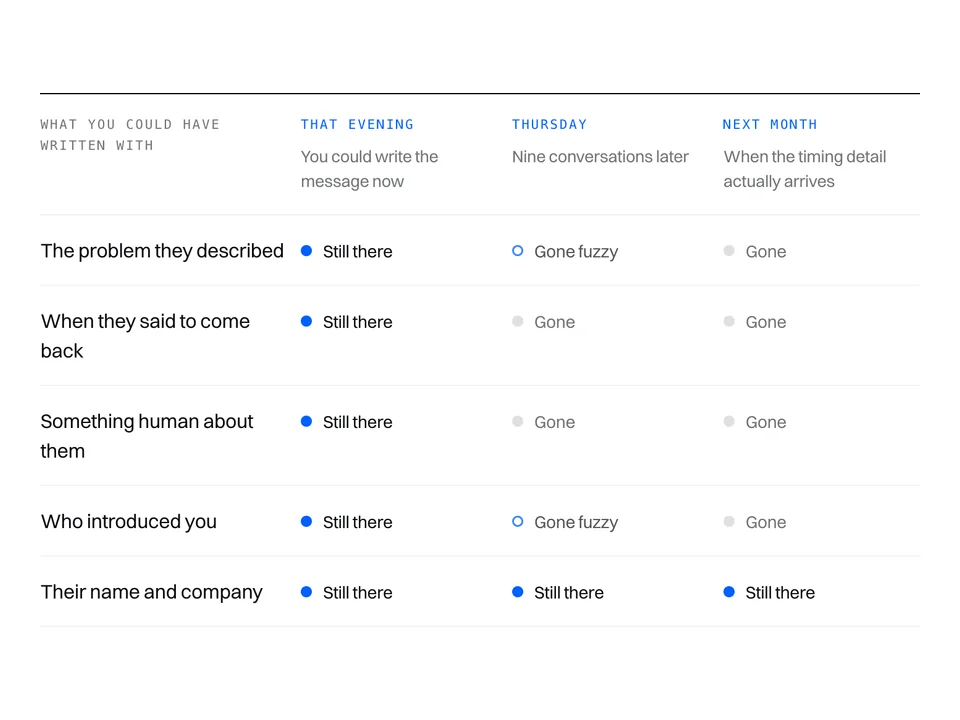
The note has to be written before the next conversation starts. By the end of the evening the conversations have merged, and the specifics are the first thing to go.
At an event you are meeting people back to back. Each new conversation overwrites a little of the last. By the time you are on the train home you will remember that you met “the logistics woman” and not what she needed or when.
So the habit is not “write notes after the event”. It is: step away, write one sentence, then go and talk to someone else. Thirty seconds by the drinks table. If you need an excuse, checking your phone at a networking event is the least remarkable thing anyone has ever done.
- Say it rather than type it. Every phone keyboard has a microphone key. Dictating one sentence takes about as long as saying it.
- Write it where the contact is. A note in a separate app is a note you will not find next to the name when you need it.
- Put the date in the sentence. “Next Tuesday” means nothing in three weeks. “Tuesday 29th” still does.
Create my free cardThe card, the exchange and the notes are free forever.
What this looks like in Cardr.
In Cardr you type or dictate that one sentence and it is filed into those five fields for you to check. The follow-up date comes from the words you used, worked out in your own time zone.
This is the real contacts page, on a demo account with made-up people. The sentence at the top was typed once; everything below it is what Cardr filed it into, waiting for a person to check it before anything is saved.
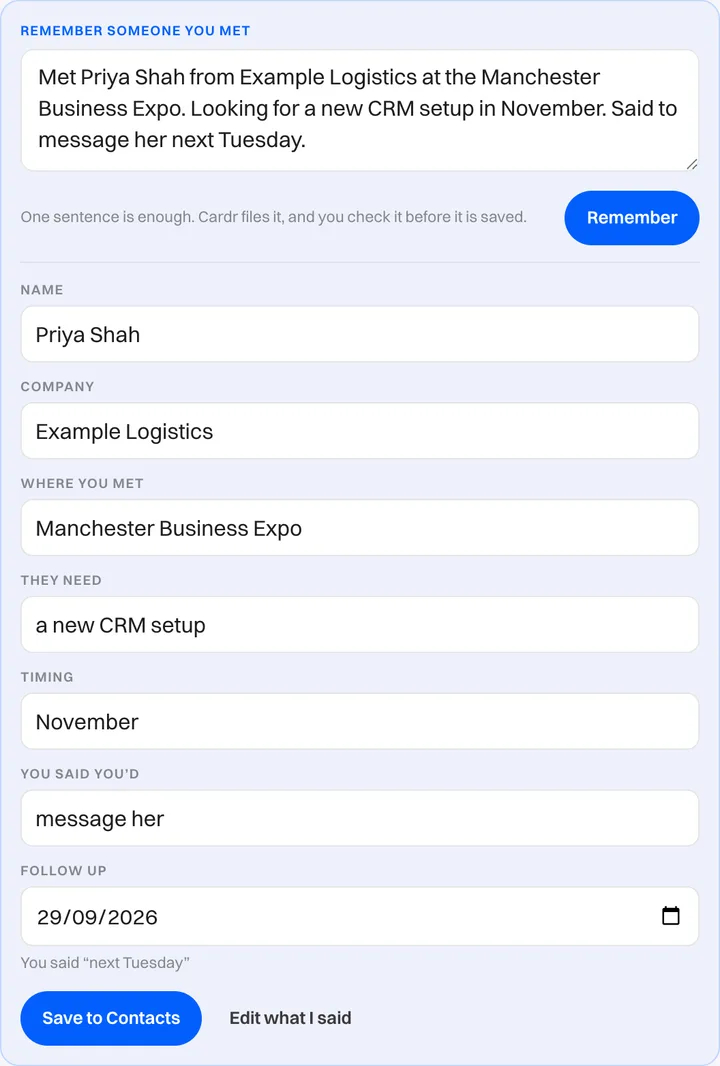
- One sentence, typed or dictated with the phone keyboard’s microphone.
- Filed into who, company, where, need and timing, for you to correct.
- “Next Tuesday” resolved to a date, with the words it came from shown under it.
- Nothing is stored until you press Save.
Two things about this are deliberate. First, nothing is saved until you press Save. The filing is a suggestion; you are the one who knows what she said. Second, the date is worked out in code, in your own time zone, from the words you used. “Next Tuesday” becomes a date on the screen, and the screen tells you which words it read.
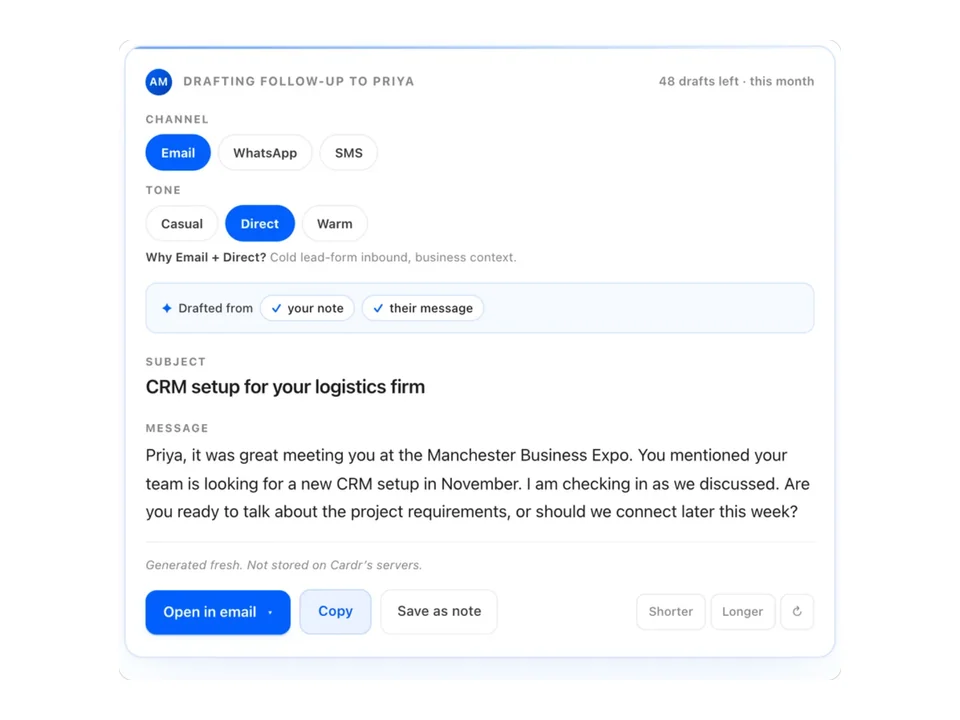
Remembering someone this way is on the free plan, like every note. What Pro adds is being reminded on that day and having the message drafted from the sentence, which is the subject of when to follow up and what to write.
Every way to keep the note, compared.
Any method works if you use it within five minutes and it keeps the note next to the name. Most fail on the second condition, not the first.
| Method | Fast standing up | Note sits with the contact | Reminds you on the day | Cost |
|---|---|---|---|---|
| Back of their paper card | Yes, if you have a pen | Until the card is lost | No | Free |
| Phone notes app | Yes | No, a separate app | Only if you set one | Free |
| Notes field in Contacts | Slower: it sits inside the contact | Yes | No | Free |
| A CRM | Usually not on a phone | Yes | Yes, if set up | Per seat |
| Cardr | Yes, one dictated sentence | Yes | Yes, on Pro | Notes free; reminders on Pro |
Ours is in the list, so read the last row with that in mind. If you already live in a CRM and open it on your phone, keep using it.
The honest ranking is: whichever of these you will actually use standing up, one-handed, with a drink in the other hand. A notebook beats software you do not open.
Remembering names in the room.
Use the name once straight away, ask one question about it, and connect it to where they work. That is enough to hold a name for the length of an event.
The note handles next week. In the room you still need the name for the next ten minutes, when someone joins the conversation and you have to introduce them.
- Say it back once. “Good to meet you, Priya.” Once, naturally. Not three times like a sales course.
- Ask about it. Spelling, pronunciation, whether they go by the short version. A question makes you process the name instead of hearing it.
- Hang it on the company. “Priya from Example Logistics” is easier to hold than “Priya”, and it is how you will introduce her anyway.
- Swap details before you part. If they have your details and you have theirs, the name is written down for you. With a Cardr pass the exchange is two-way: they scan your code, and their details come back to you in the same step.
From memory to a message that gets sent.
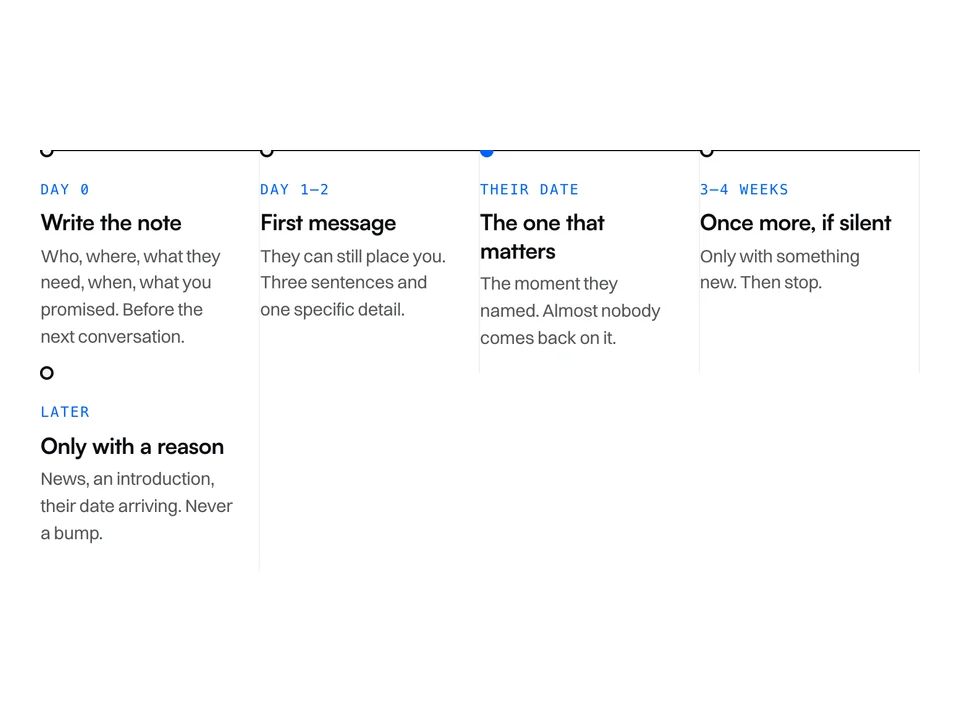
A note is only worth writing if it turns into a message. Send the first one within two days, and come back on the date they named.
The five facts map straight onto a follow-up. Where you met is the opening line. What they need is the reason to write. What you promised is the thing you attach. The timing tells you when, which is the part almost everyone gets wrong. We wrote the cadence up separately: the day, the week and the month, and a set of UK follow-up email templates built on exactly these five facts.
If you work a particular kind of room regularly, the details that matter change a little. An estate agent needs the move date, a recruiter needs the notice period, a founder needs the round timing. The method is the same.
Create my free cardAbout a minute. Nothing for the other person to install.
Questions, answered.
How do you remember people you meet at networking events?
Write down five things about each person within five minutes of the conversation: who they are, where you met, what they need, when to come back to them, and what you promised. One sentence covers all five. Do it before the next conversation starts, not at the end of the night.
What is the best app to remember people you meet?
The one that keeps the note next to their contact details and that you will open while standing up. A phone notes app works if you are disciplined about names. Cardr files a dictated sentence into those five fields against the contact and works out the follow-up date; the note-taking is free.
How do I remember names at an event?
Say the name back once, ask one question about it such as spelling or pronunciation, and attach it to their company. Then swap details before you part, so the name is written down for you.
Should I write notes on the back of business cards?
It works, and it is better than nothing. The problem is later: the card goes in a pocket, the note never reaches your phone, and you cannot search it. If you use paper, photograph the card and the note the same evening.
Is it rude to take notes at a networking event?
Not if you step away to do it. Writing mid-conversation can feel like an interview; a sentence typed or dictated between conversations is invisible. Many people tell the other person they are noting the thing they promised, which comes across as reliable rather than rude.
Keep reading
This is part of How to follow up after networking. Every other guide is on the guides index.
Free forever. About a minute to build.
Nothing for the other person to install, and no card details to start.