Networking follow-up email templates Six follow-up emails, written for UK inboxes.
Every template here is three to five sentences, uses one specific detail from the conversation, and asks for something small or nothing at all. Copy them; then change the one line that makes each one yours.
A good networking follow-up email in the UK is three to five sentences long, uses their first name, opens with where you met, references one specific thing they said, and ends with a small ask or none. Below are six templates for the six situations that come up after an event, each with the line you must personalise marked in square brackets. A template with the brackets left generic is a mailshot, and it will be read as one.
What every good one has in common.
Five parts, in this order: their name, where you met, the specific thing, a small ask or none, and a short sign-off. Anything longer than a phone screen is too long.
- Their first name. “Hi Priya,” is standard UK business email. “Dear Ms Shah” reads as a letter from a solicitor.
- Where you met, in the first line. They met twenty people. Give them the anchor before anything else.
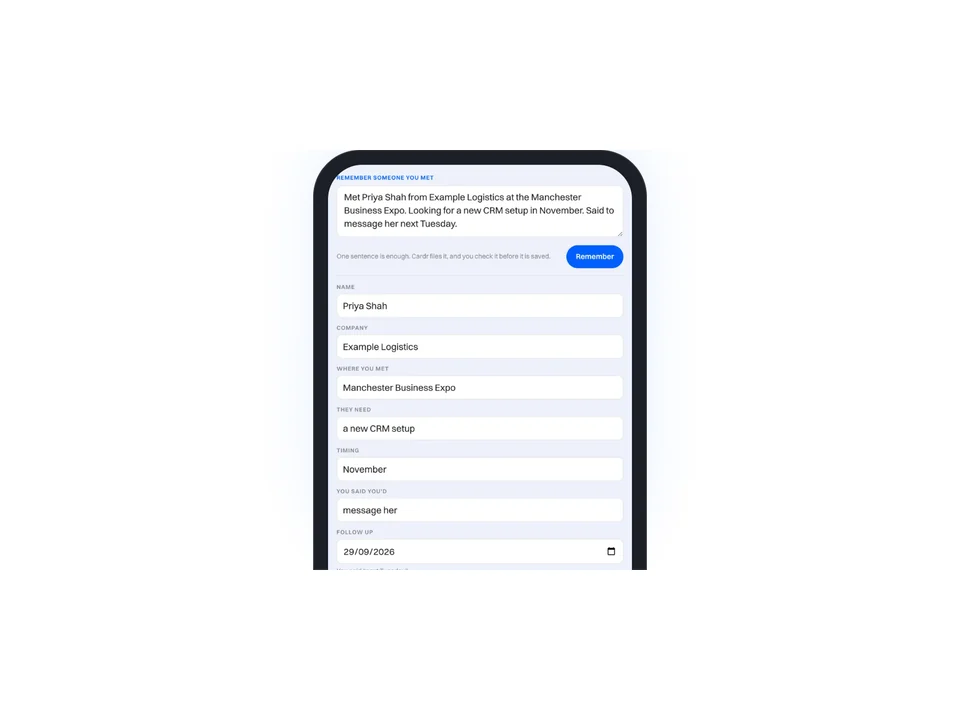
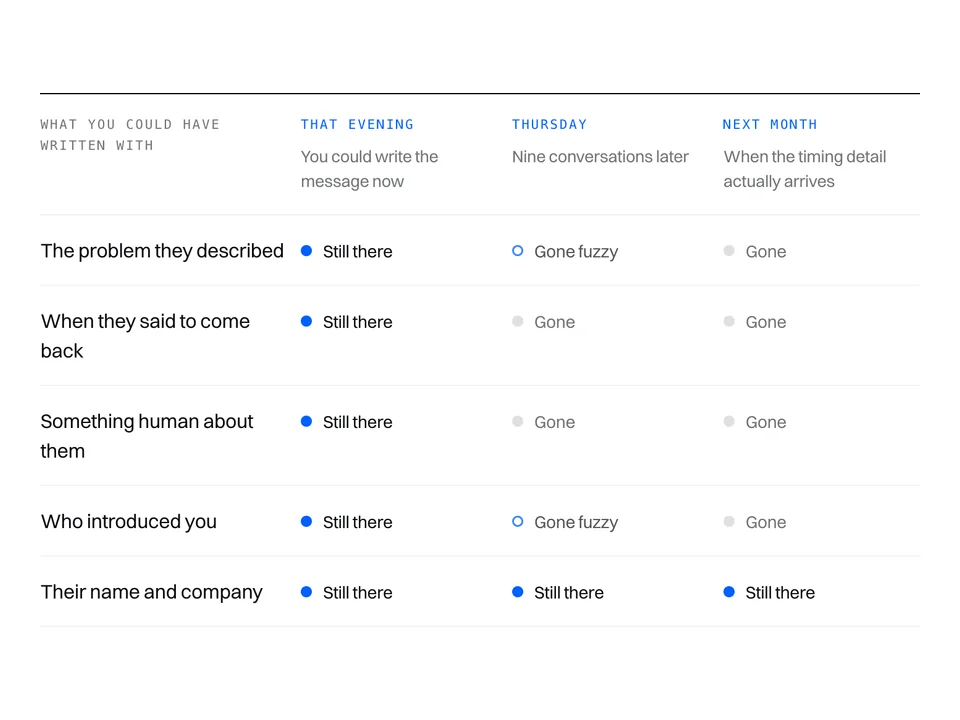
- One specific thing they said. This is the only line that proves the email is not a mailshot, and the only one a template cannot write for you. It comes from the note you took; here is how to take it.
- A small ask, or none. Something that costs them a sentence. “Would a quick call next week be useful?” is fine. “Can we set up a 45-minute discovery session?” is not, yet.
- A plain sign-off. “Best,” “Thanks,” or “Cheers,” if the conversation was relaxed. Then your name and one way to reach you.
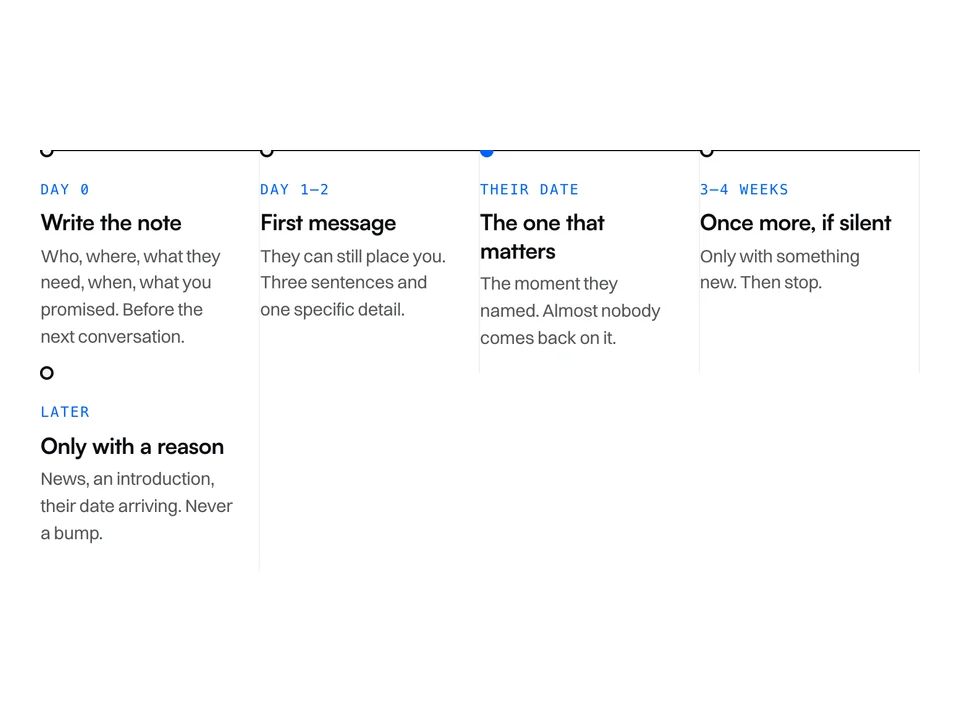
Send it within one to two days. Why that window, and when to send the second one.
The next morning.
Use this for most people you want to stay in touch with. It references one detail, offers nothing heavy, and is answerable in a line.
Hi [first name],

Good to meet you at [event] yesterday. I've been thinking about what you said about [the specific problem they described].

[One sentence: a thought, a question, or something useful.]

Would a quick call be useful in the next couple of weeks? No problem if not.

Best,
[Your name]
[Phone or card link]
The bracket in the second paragraph is the whole email. “What you said about moving the warehouse team onto one system before the November peak” gets a reply. “What you said about your business” does not.
When you promised to send something.
Send the thing you promised, and nothing else. This is the easiest follow-up to write and the most noticed when it never arrives.
Hi [first name],

As promised at [event], here's [the article / the case study / the contact] I mentioned: [link or attachment].

The part I thought you'd find useful is [one line on why it fits what they told you].

Good to meet you.
[Your name]
No ask at all here, and that is deliberate. The message is proof you do what you say, which is worth more than a meeting request.
When they told you when.
Use this on the date they gave you, however long after the event that is. It reminds them they asked, which is why it works.
Hi [first name],

When we met at [event] in [month], you said [November / after the funding / once the new hire started] would be the right time to talk about [their need].

So here I am, as promised. Is it still on the cards?

Best,
[Your name]
This is the most valuable email on the page and the one almost nobody sends, because almost nobody still has the date. If you only keep one habit from this post, write the date down on the day.
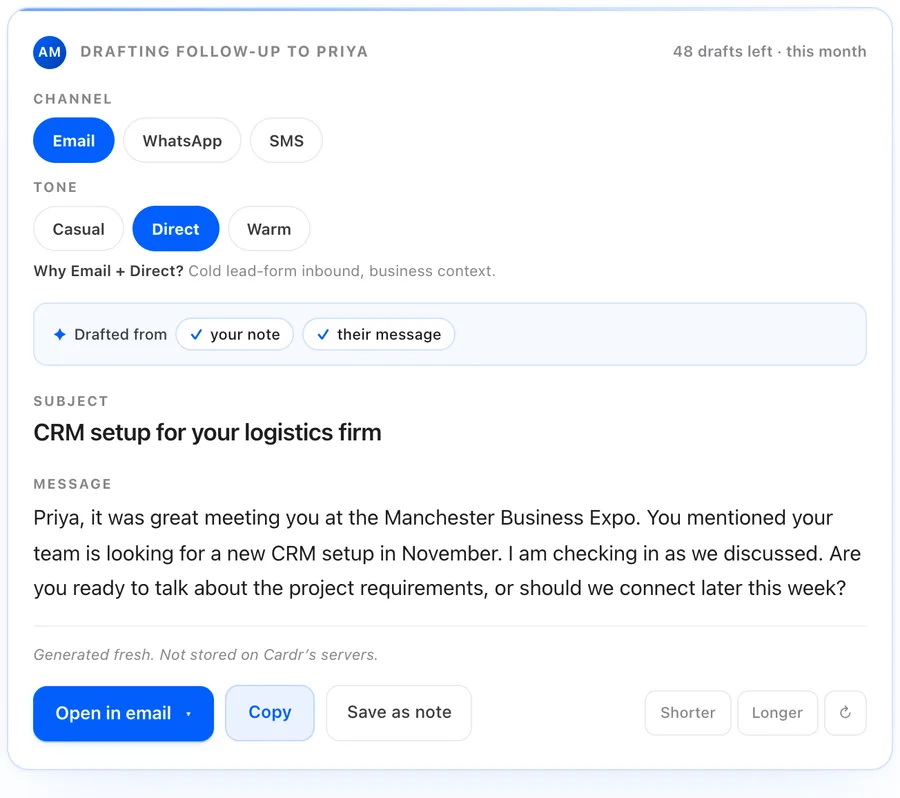
- Channel and tone are yours to pick; Cardr suggests one and says why.
- Drafted from shows exactly what it read: your note and their message. Nothing else.
- The specific line — the expo and the November CRM project — comes from the one sentence saved against the contact.
- Open in email hands it to your own mail app. Cardr never sends it for you.
That draft is the product doing templates two and three for you: written from the note on the contact and the message they left, in the channel and tone you choose, and never sent without you pressing the button.
The speaker, the introduction, the last nudge.
Three rarer situations, each with its own rule: be specific to the talk, ask before introducing, and make the last message genuinely last.
Hi [first name],

I was in the audience at [event] for your [talk / panel]. The point about [one specific thing they said] has stuck with me, because [one line on why it applies to you].

No ask. I just thought you'd like to know it landed.

Best,
[Your name]
Hi [first name],

At [event] you mentioned you were looking for [need]. I know [name] at [company], who [one line on why they fit].

Would an introduction be useful? I'll only send it if you say yes.

Best,
[Your name]
Hi [first name],

I'm conscious you'll have had a busy few weeks since [event], so this is the last I'll send on it.

[One new thing: a relevant article, a result, a piece of news about their sector.]

If the timing's better later in the year, just say and I'll come back then.

Best,
[Your name]
Ask before introducing, always. A double opt-in introduction protects both people’s time and makes you the person people are glad to be introduced by. And mean “last” when you write it.
Create my free cardThe exchange brings their email back to you, so you have somewhere to send these.
On WhatsApp or by text.
If they gave you a mobile and said to message, a text is fine. Cut the template to two lines and drop the subject.
Hi [first name], it's [your name] from [event] yesterday. Still thinking about [the specific thing]. Coffee in the next couple of weeks?
Use the channel they chose. A phone number given with “just WhatsApp me” is an invitation; a phone number on a business card is not. If in doubt, email.
Mistakes that make a good template bad.
Leaving the brackets generic, writing too much, and asking for too much too soon. All three turn a follow-up into a mailshot.
- Generic brackets. “I enjoyed our conversation about your business.” Everyone can tell.
- Attaching your deck. They did not ask for it. Offer it.
- A calendar link as the first message. It turns a conversation into an appointment they did not agree to.
- “Just checking in” or “bumping this”. It asks them to do the remembering. Template 6 carries something new instead.
- Sending the same email to everyone from the event. People compare notes more than you would think.
If you meet a lot of people for work, the same rules hold in every trade. We wrote up what changes for sales teams, consultants and freelancers.
Questions, answered.
How do you write a follow-up email after a networking event?
Three to five sentences: their first name, where you met in the first line, one specific thing they said, a small ask or none, and a short sign-off. Send it within one to two days.
What subject line should a networking follow-up have?
Something that names the event or the thing you promised, such as "Good to meet you at the Manchester Expo" or "The case study I mentioned". They need to place you before they open it.
How long should a networking follow-up email be?
Short enough to read on a phone without scrolling. Three to five sentences is plenty.
Is it OK to follow up on LinkedIn instead of email?
Yes, if that is where they suggested. A connection request with a one-line note referencing the conversation works. It is a weaker channel for anything with an attachment or a date in it.
Can Cardr write these for me?
On Pro, Cardr drafts a follow-up from the note you kept and anything they sent you, by email, WhatsApp or SMS, in the tone you pick. You edit it and send it yourself. Free accounts get one draft per card to try it.
Keep reading
This is part of How to follow up after networking. Every other guide is on the guides index.
Free forever. About a minute to build.
Nothing for the other person to install, and no card details to start.