How to follow up with people you meet Capture it, send it, come back on time.
Following up is not one message. It is a small routine that starts before you walk away and ends, sometimes months later, on a date the other person gave you.
To follow up with someone you met, write down five facts about them within five minutes, send a short message within one to two days that mentions one specific thing they said, and come back on the date they named. If they go quiet, send one more message after three to four weeks with something new in it, then stop. Keep every person on one list with one next date each. None of this needs software; a tool only makes the dull parts cheap enough that you keep doing them.
The system on one page.
Six steps. The first two happen at the event, the next three over the following month, and the last one is what keeps it working for a year.
A follow-up rarely fails at the message. It fails earlier, when nothing specific is left to say, or later, when you meant to come back in November and did not. Here is the whole thing in order.
-
01
Write five facts down within five minutes
Who they are, where you met, what they need, when to come back, and what you promised. One sentence, before the next conversation starts.
-
02
Leave with their details, not just yours
A card handed over is a hope. An email address or phone number in your own phone is a follow-up you can actually send.
-
03
Send the first message within one to two days
Three to five sentences, their first name, where you met, and the one specific thing they said. A small ask or none.
-
04
Come back on the date they gave you
“After the funding closes”, “in November”. Write it down as a date on the day, and be the one who remembers it.
-
05
If they go quiet, send one more and then stop
After three to four weeks, with something new in it. Two unanswered messages is the line, except when their date arrives.
-
06
Keep one list, with one date per person
Every person you mean to follow up, the next date for each, and a way to mark it done. Months later, that list is the whole system.
Each step has its own guide if you want the detail:
- Step 1: how to remember people you meet, and the five facts worth writing down.
- Why step 1 matters: why follow-ups fail on Thursday, not on the night.
- Steps 3 to 5: when to follow up, stop by stop.
- The message itself: six UK follow-up email templates, or what to write on LinkedIn if that is where they are.
- Step 6: phone contacts, a spreadsheet or a personal CRM, compared.
At the event: five facts and their details.
The follow-up is written at the event, not afterwards. What you capture in the thirty seconds after a conversation is the raw material for everything later.
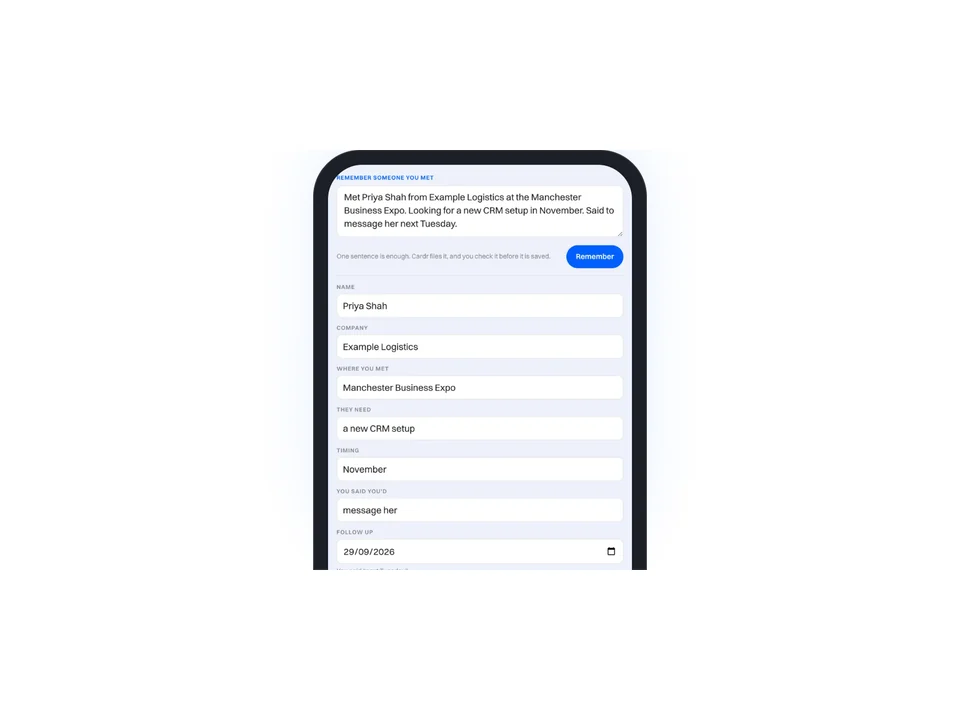
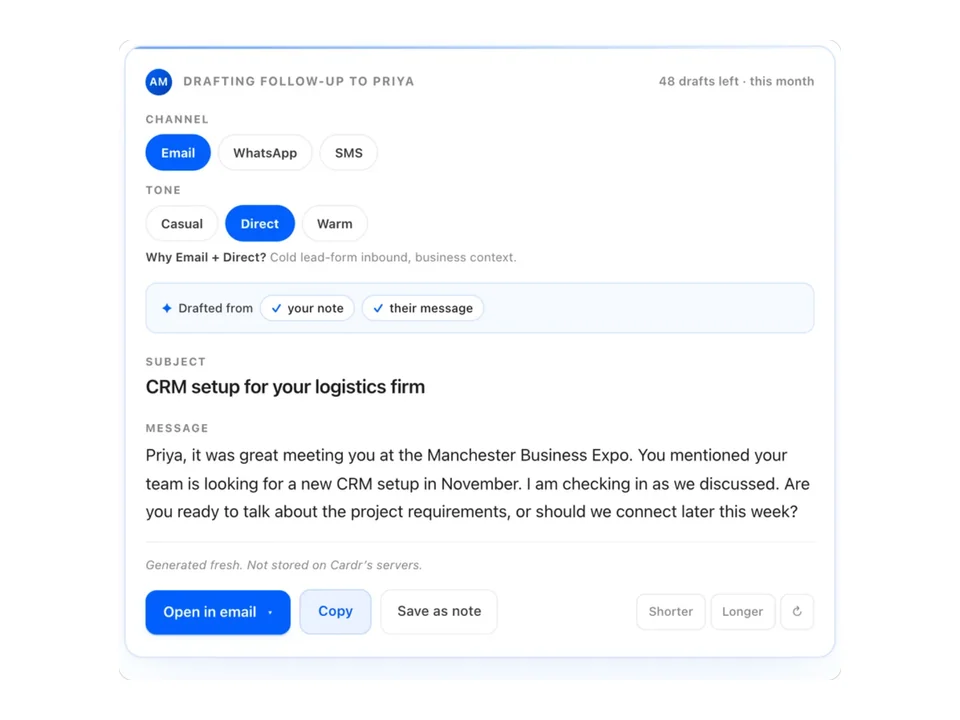
The five facts are who, where you met, what they need, when to come back and what you promised. Only the first could be read off a badge. The other four are facts about the conversation, nobody else has a record of them, and they are the first things you forget. One dictated sentence covers all five: “Priya, Example Logistics, Manchester expo, wants a new CRM in November, said I’d send the case study.” (A made-up person, like every example on this page.)
The second half of the job is leaving with a way to reach them. Handing someone your card puts the follow-up in their hands, and they have twenty other cards. Ask for their email or number, or use a card that swaps details both ways. With a Cardr Apple Wallet card, the other person scans your QR, lands on your page, saves you to their contacts and can send their details back in the same step, so the exchange ends with them in your list.
The first message, within two days.
Short, specific and soon. Their first name, where you met, the one thing they said, and a small ask or none. It should fit on a phone screen.
Within one to two days they can still place you; after a week you are reintroducing yourself. The detail that makes it work is the specific line: “what you said about moving the warehouse team onto one system before the November peak” gets a reply; “what you said about your business” does not.
Use the channel they gave you. A business email means email. “Just WhatsApp me” means WhatsApp. If you only have their name and company, LinkedIn is the usual route, with its own limits on what you can say in a connection note; we cover those in what to send on LinkedIn.
The second and third, and when to stop.
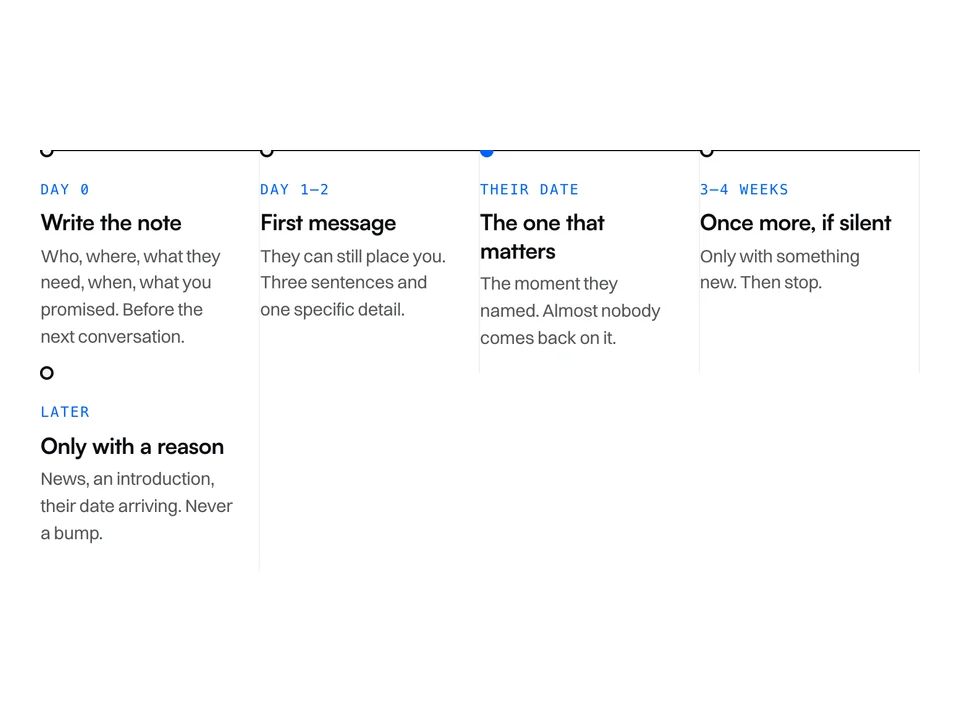
The date they gave you beats every rule. Without one, send a single further message after three to four weeks, carrying something new, and then stop.
This is where the value is, and the part that is easiest to let slide. The rules are short enough to fit in one decision:
After the first message, what next?
- They replied Answer, and do what you said You are in a conversation now. The only follow-up rule left is to keep your promises, on the dates you gave.
- They named a date Write on that date Whatever happened before. By then they have usually forgotten saying it, which is why coming back on it works.
- Silence, and no date Once more, after 3 to 4 weeks Only with something new in it: an article, an introduction, news from their sector.
- Silence twice Stop A third unanswered message turns you into the thing they are ignoring. Keep them on the list without a date.
- A real reason turns up later Write, once A job change, a problem you can now solve, an event you will both be at. A reason, never a bump.
“Just checking in” and “bumping this” are not follow-ups. They ask the other person to do the remembering. Every message after the first should carry something: the date arriving, an article that fits their problem, an introduction they would want. If you have nothing new, you do not have a reason to write yet.
There are no reply rates here because nobody has measured them honestly for UK networking conversations, and we will not invent one. The timing guide gives the reason for each stop instead.
Keeping track for months, not days.
Two weeks after an event you can hold it in your head. Four months later you need a list: each person, their note, their next date, and whether you have written.
Someone who said “come back in the spring” in October is a real opportunity in March, but only if you still know who they are, what they needed, and that March is their month. That needs somewhere to live that is not your memory.
- One list. Notes in one app and contacts in another means the note is never beside the name when you need it.
- One next date per person. Not a vague “follow up sometime”. A date, written as a date, that something will show you on the day.
- A way to mark it done. Otherwise the list fills with people you have already written to, and you stop trusting it.
That can be your phone’s Contacts app plus calendar reminders, a spreadsheet, a personal CRM, or Cardr’s contact list. Each wins somewhere; we compared them fairly in personal CRMs for networking.
By hand, or with Cardr doing the dull parts.
Everything above works with a notebook and a calendar. Cardr keeps the list and the notes for free; Pro reminds you on the day and drafts the message.
Being straight about the split, since we sell the paid half:
- Free, for good: your card and signed Wallet pass, the two-way exchange that puts their details in your list, Meeting Memory (one sentence filed into who, where, need and timing, with the follow-up date worked out from your words), notes, tags, search, and export to CSV or vCard. One AI-drafted follow-up to try.
- Pro, £12 a month or £9 a month billed annually (£108 a year): a reminder email on the date in your note, or on day 3 after you met if you gave none; AI-drafted follow-ups for 200 people a month by email, WhatsApp or text, written from your note; a capture form on your page; and all sixteen card designs.
- Not built: sending on your behalf, sequences of automatic follow-ups, and connections to other CRMs. Cardr drafts and you press send. If you write to someone another way, “Mark followed up” stops the reminders about them.
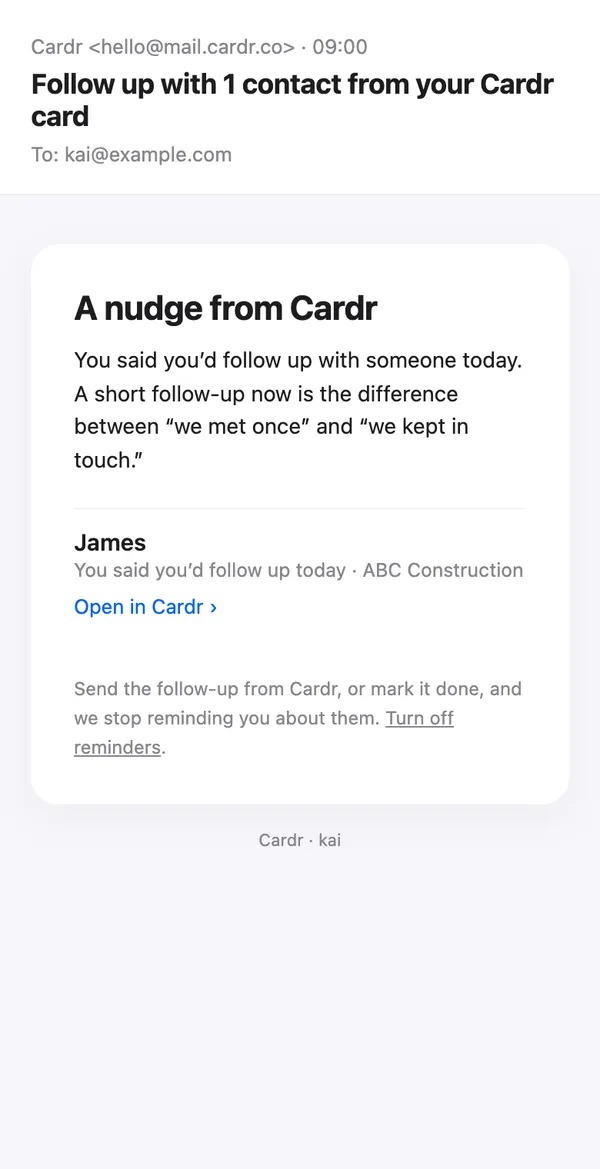
- Sent on the date your note named, or day 3 if it named none. Pro only.
- One link, straight to the contact with the draft a tap away.
- Mark it done, or send from Cardr, and the reminders about them stop.
What a tool cannot do is capture the specific thing for you. If you take one habit from this guide, make it the sentence written before the next conversation. The rest, including the meeting memory that files it, is there to make sure that sentence turns into a message.
Create my free cardFree forever. Pro starts with 7 days free, and 30 days to change your mind after that.
Questions, answered.
How do you follow up with someone you just met?
Send a short message within one to two days: their first name, where you met, one specific thing they said, and a small ask or none. Then come back on any date they gave you.
How many times should you follow up after meeting someone?
Twice if they do not reply: once within two days, and once more after three to four weeks with something new. Then stop, unless they named a date, which is always a legitimate reason to write again.
Is it OK to follow up if they never replied?
Once, with a real reason: something new that fits what they told you, or the date they named arriving. A message that only says you are checking in asks them to do the remembering, and usually goes unanswered.
How do I keep track of people I meet for work?
One list with every person, a note on what they need, one next date each, and a way to mark it done. Phone contacts with calendar reminders, a spreadsheet, a personal CRM or Cardr all work; what fails is notes in one place and contacts in another.
Should I follow up by email or LinkedIn?
Use the channel they gave you. An email address means email, which is better for anything with an attachment or a date in it. If you only have their name and company, a LinkedIn connection note referencing where you met is the usual route.
Does Cardr send follow-ups automatically?
No. On Pro it reminds you by email on the day and drafts the message from your note, and you read it and send it yourself. On Free you keep the contacts, notes and dates, and write the messages yourself.
Keep reading
This is part of How to follow up after networking. Every other guide is on the guides index.
-
How to remember people you meet
Five facts, written down within five minutes. Everything else is optional.
-
When to follow up after meeting someone
Three moments, and the most important one is the date they told you.
-
Networking follow-up email templates
Six short templates, and the one line in each you have to change.
Free forever. About a minute to build.
Nothing for the other person to install, and no card details to start.