Do 88% of business cards get thrown away? 88% of cards binned in a week? We traced it.
It is the most repeated number in our category, and we sell digital cards, so we have every reason to want it true. We followed it back through every citation we could find instead.
Kai, Founder of Cardr · 12 min read
Nobody has shown that 88% of business cards are thrown away within a week. The earliest instance we found is a 2012 Statistic Brain page that named CNN, BusinesscardABC and Freelance Folder as its sources; archived copies of all three contain no such figure. A 2016 Adobe blog post, written by a print company, repeated it without a source, and most modern citations lead back there. That does not make it false: as far as we can find, nobody has measured it either way. Cardr sells digital cards, so we have a reason to want the number to be true. We checked it instead.
Is the 88% statistic real?
It is untraceable. It has been repeated for fourteen years, but no version of it we could find points to a study, a survey, a sample size or a method.
We took four numbers that turn up together on digital card sites, printer blogs and in the press: that 88% of business cards are thrown away within a week (sometimes “in less than a week”), that 10 billion are printed a year, that 27 million are printed a day, and that they cost 7.2 million trees a year. For each one we followed the citation to the page it named, then that page’s citation, until the trail ran out. Where a page no longer exists we read it in the Wayback Machine. Every page below was opened on 23 September 2026.
The short version is in the table. The rest of the page is the working.
| Claim | Earliest instance we found | Where citations lead now | Verdict |
|---|---|---|---|
| 88% thrown away within a week | Statistic Brain, July 2012. Its three named sources do not contain it | Adobe blog 2016, written by a print company; CreditDonkey, citing Adobe | Untraceable |
| 10 billion printed a year (US) | Statistic Brain, July 2012, same table | Vendor and printer blogs, via CreditDonkey | Untraceable |
| 27 million printed a day | Statistic Brain, July 2012: 10 billion ÷ 365 | The BBC (2021), via a printer’s blog; Wikipedia, via the BBC | Untraceable; derived, not measured |
| 7.2 million trees a year | A 2021 blog post written with a digital card app | Digital card vendor and printer pages, unsourced | Untraceable |
Every page opened on 23 September 2026, live or as a Wayback Machine capture. “Untraceable” means we found no study, survey, sample size or method behind the figure. It does not mean the figure is false.
Where does the 88% figure come from?
A 2012 statistics page, as far as we can trace it. Everything since either copies that page or copies something that copied it.
Most modern citations point to one of two places: a 2016 post on Adobe’s blog, or CreditDonkey, whose business card statistics page (updated 20 July 2022) says “Of all cards printed each year, 8 billion will be tossed within a week. That’s 88% of cards printed” and lists Adobe as its source. So the question becomes where Adobe got it.
The Adobe post, dated 26 October 2016, carries four numbers and cites nothing for any of them. It also says who wrote it: “This post was written by Silkcards”, with a link to a print company, not by an Adobe researcher. Its four figures are a sales rise of 2.5% for every 2,000 cards handed out, the 88%, 63% of people binning a card because they do not need the service, and colour cards being kept ten times longer. Those are the same four figures, in the same order, as a table on Statistic Brain, a statistics website, four years earlier.
The Statistic Brain page, archived on 26 July 2012, lists “Percent of business cards handed out that will be thrown out in less than a week: 88%”. It names three sources: “CNN, BusinesscardABC, Freelance Folder”, with a verification date of 18 July 2012. It gives no study, no sample and no method for that row.
“Percent of business cards handed out that will be thrown out in less than a week: 88%” — “Statistic Verification Source: CNN, BusinesscardABC, Freelance Folder. Date Verified: 7.18.2012”
The earliest instance of the 88% figure we found. No study, sample or method is given for it, and the three named sources, read in the archive, do not contain it.
“Statistic #2 – 88% of business cards handed out get thrown away in less than a week.” — “This post was written by Silkcards.”
The source most modern pages cite, directly or through CreditDonkey. It cites nothing, and its four figures match the 2012 Statistic Brain table in the same order.
So we read the three sources. None of them contains the number.
- CNN. The closest match is a CNN article from October 2009 on digital alternatives to paper cards. It quotes Mashable’s editor saying “people get a [business] card and don’t do anything with them”. It gives no percentage and no printing volume.
- Freelance Folder. Its January 2011 post “7 Reasons Why Your Business Card Gets Thrown In the Bin” was written on behalf of the printer MOO. It says “We all collect business cards, and we all throw most of them away.” It gives no figure.
- BusinesscardABC. The archive has no site by that exact name. The nearest is businesscardsabc.com, and its page captured in February 2010 says “more than 90% of business cards wind up in the trash the day they’re received.” It is a different number and a different time frame, and it has no source either. We read the site’s other archived articles and found no 88%.
By 2016 the same Statistic Brain page had added “Statistic Brain Research Institute” to its source list. It had also added a poll “conducted by Statistic Brain Research Institute online from 842 working professional respondents”. That poll asked whether people judge a company by its card; it was not about throwing cards away, and the 88% row sits outside it. Later captures replace the source list with “LOGIN TO VIEW SOURCES”.
The table was already travelling by then. In November 2015 Ryan Holmes’s essay on Medium said “Of the 27-million-plus business cards printed each day in the US alone, 88 percent are tossed away within a week of receiving them”, linking straight to Statistic Brain.
- Feb 2010 BusinessCardsABC “More than 90%”, binned “the day they’re received”. A different number, unsourced.
- Jul 2012 Statistic Brain 88% “in less than a week”. Names three sources; none contains it.
- Nov 2015 Ryan Holmes, Medium Repeats 88% and 27 million a day, linking Statistic Brain.
- Oct 2016 Adobe blog Same four figures, same order. Written by a print firm. No source.
- 2019–22 “A study from Adobe” LinkedIn in 2019; CreditDonkey cites Adobe by 2022.
- Today Vendor pages Cite CreditDonkey, or each other. One now calls it a survey.
What about 10 billion a year and 27 million a day?
They are the same number, and it has been restated twice on its way to Wikipedia.
The 2012 Statistic Brain table lists 10 billion cards printed in the US each year and 27,397,260 printed each day. The daily figure is not a second measurement. It is exactly 10 billion divided by 365. Neither number has a source beyond the three pages above, and none of them mentions printing volume.
Then it travelled. An Aura Print blog post, archived in January 2022, took “around 27 million” a day and multiplied it “by just the working days in a year” to reach 7,047,000,000. That is 27 million times 261. In September 2021 the BBC wrote that before the pandemic cards were being printed “around the world. One estimate put it at 27 million per day, or more than seven billion each year”, linking to that Aura post. Wikipedia’s business card article now says “approximately 7 billion business cards were printed around the world every year”, citing the BBC.
That puts two different numbers in circulation. The US figure of 10 billion became a worldwide figure of 7 billion, three billion smaller, because of a working-days multiplication in a printer’s blog post. We are not saying either is wrong. We found nothing to suggest anyone counted.
- Jul 2012 10 billion a year Statistic Brain: “printed in the US annually”. No method.
- Same page 27,397,260 a day Exactly 10 billion ÷ 365. Derived, not counted.
- 2021 7,047,000,000 Aura Print: 27 million × working days (261). Read in a January 2022 capture.
- Sep 2021 “Around the world” The BBC: “more than seven billion each year”, linking Aura Print.
- Now Wikipedia “Approximately 7 billion” worldwide, citing the BBC.
And 7.2 million trees a year?
Untraceable. We found it on several pages and none of them shows a source or a sum.
The earliest dated use we found is a Changeit blog post whose address dates it to 25 June 2021. It says “7.2 million trees can be saved every year” by switching to a digital card, and notes it “was written in cooperation with the Contapp team”, a digital card app. It cites nothing. Wave Connect’s statistics page carries the same figure without a reference. Aura Print’s current post calls it “an estimated average”, again without a source. Blinq’s alternatives post uses a different number, 6 million trees, from a different source.
A tree figure depends on how many cards are printed, how much each weighs and how much paper a tree yields. All three would have to be stated for anyone to check it, and we found no version that states any of them.
“By simply switching from printed business cards to a digital solution such as Contapp, it means: 7.2 million trees can be saved every year.”
The earliest dated use of the 7.2 million figure we found. No source, no card count, no weight per card and no yield per tree.
What is actually known about paper card waste?
Less than the statistics pages suggest. Nobody we found has measured what happens to a card after it is handed over.
Three sources say something real about paper cards, and none of them answers the 88% question.
| Source | What it measured | Method | What it says about cards being thrown away |
|---|---|---|---|
| Ipsos, February 2024 | Whether British adults use paper cards: “only 23% of adults have ever given out a physical business card”; of those, “52% stopped over 4 years ago”; the top reason for not using them is “no need for them (71%)” | “A representative quota sample of 1,089 adults aged 16-75 in Great Britain”, online, 26–29 January 2024 | Nothing. It asks about giving cards, not keeping them |
| BBC News, September 2021 | Vistaprint’s international president: “Business cards sales were down 70% globally” in late March and early April 2020, and have since recovered, especially in North America | A company’s own sales, as told to a reporter | Nothing |
| Karapetyan et al., Procedia Computer Science 52 (2015) | Life cycle impact of paper cards against a smartphone card app | Two-stage comparative life cycle assessment | Nothing on discard rates. Paper “causes slightly less environmental impact” at small scale; digital is better at the “large scale (real world scenario)” |
Read 23 September 2026. The Ipsos and BBC pages were read in full; for the 2015 study we read the published abstract. The last column is the one that matters here, and none of the three answers it.
What this adds up to: paper cards are used less than they were, and the one comparison of their environmental cost we found is closer than the tree numbers imply. What we could not find is any measurement of the thing everyone quotes, which is what a person does with a card after they receive it. If you know of one, with a method, tell us and we will add it here.
Our honest answer on whether paper cards are dead does not need the number. The real weakness of paper is that nobody retypes it into their phone, and that is plain without a statistic. We make that case row by row on digital vs paper business cards.
Why a digital card company checked.
Because we would like the number to be true, and that is exactly when a number needs checking.
Cardr makes digital business cards. A statistic saying nearly nine in ten paper cards are gone within a week is about the most convenient fact our category could have. That is the reason to check it rather than repeat it. The claims on this site have to be ones we can source, and this one cannot be sourced.
None of this is a charge against the pages that repeat it. Most cite the page in front of them in good faith, the way citations usually work. The trouble is that each step drops a little context. “Thrown out in less than a week” on a statistics page became “a study from Adobe” in a 2019 LinkedIn post. Adobe hosted it but did not write it. The same number became “according to a recent study” on Tapzo and “according to a survey by CreditDonkey” on Aura Print. Small Business Rainmaker presents it as what “business card naysayers” say, with no link, and Wave Connect cites that page. No hop added a method.
If you want to make the case against paper, there are arguments you can support. A printed card cannot change when your number does. A QR code on the card gets rid of the retyping. And a card handed over gives you nothing back, which is the problem our follow-up guide starts from. If you are going to cite 88%, cite it as what it is: a figure from a 2012 statistics page with no traceable source.
We have since followed the other famous figures back the same way, and keep what we found, with a verdict for each and the figures that do check out, on business card statistics, with the sources checked. That page is re-checked every quarter.
Questions, answered.
Is it true that 88% of business cards are thrown away within a week?
Nobody has shown it. The earliest version we found is a 2012 Statistic Brain page that named CNN, BusinesscardABC and Freelance Folder as sources, and archived copies of those three contain no such figure. We also found no study measuring the opposite, so the honest answer is that it is unknown.
Did Adobe do a study on business cards?
Not one we could find. The Adobe source people cite is a 26 October 2016 post on Adobe’s blog that says it “was written by Silkcards”, a print company. It lists four statistics with no sources, and they match a 2012 Statistic Brain table figure for figure, in the same order.
How many business cards are printed each year?
No measured figure we could trace. The 10 billion a year for the US and 27 million a day both come from the same unsourced 2012 table; 27 million is 10 billion divided by 365. The “7 billion worldwide” on Wikipedia traces through the BBC to a printer multiplying 27 million by working days.
Where does the 7.2 million trees figure come from?
We could not trace it. The earliest dated use we found is a 2021 blog post written with the digital card app Contapp, which cites nothing. Later pages repeat it without a source, and at least one uses 6 million instead. None shows the card count, weight or paper yield a tree figure would need.
Are digital business cards better for the environment than paper?
It depends on scale. The one peer-reviewed comparison we found, a 2015 life cycle assessment in Procedia Computer Science, found paper cards had slightly less impact at small scale and digital cards less at a larger, more realistic scale. It is one study, from 2015, and phones have changed since.
Can I cite this page?
Yes. Every hop is linked, most to a dated Wayback Machine capture so it cannot change underneath you, and each was opened on 23 September 2026. If you find an earlier instance of the 88% figure, or a study with a method behind it, tell us and we will update the chain.
Keep reading
This is part of Digital business cards. Every other guide is on the guides index.
-
Digital cards5 min read
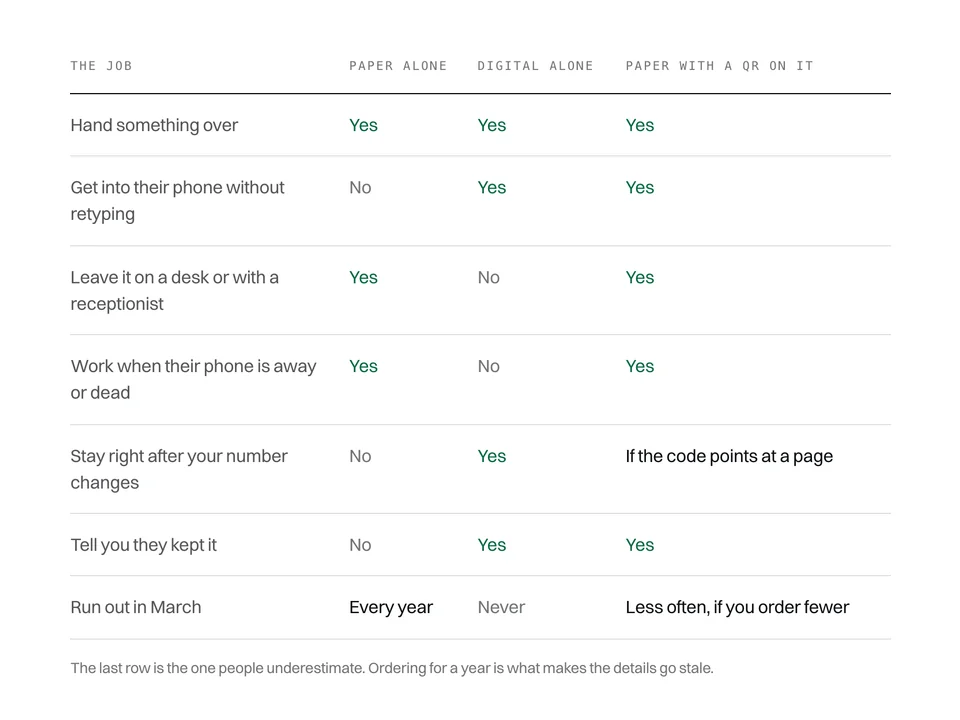
Are paper business cards dead?
No. And the places paper still wins are specific enough to name.
-
NFC & QR6 min read
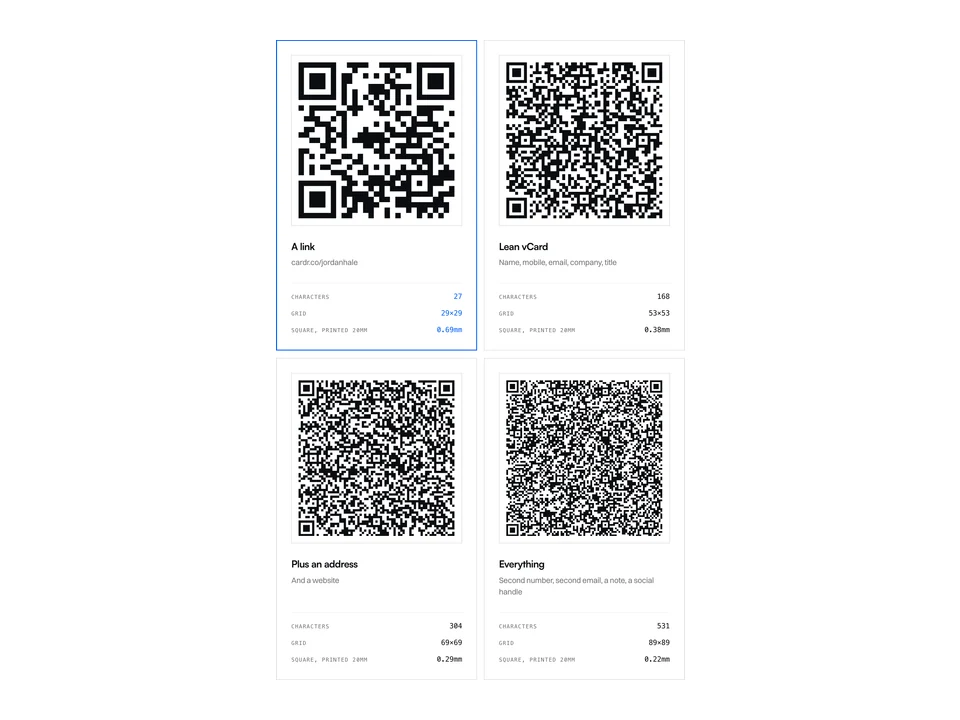
How to make a vCard QR code
The raw kind fails quietly. Here are four real codes showing exactly when.
-
NFC & QR5 min read
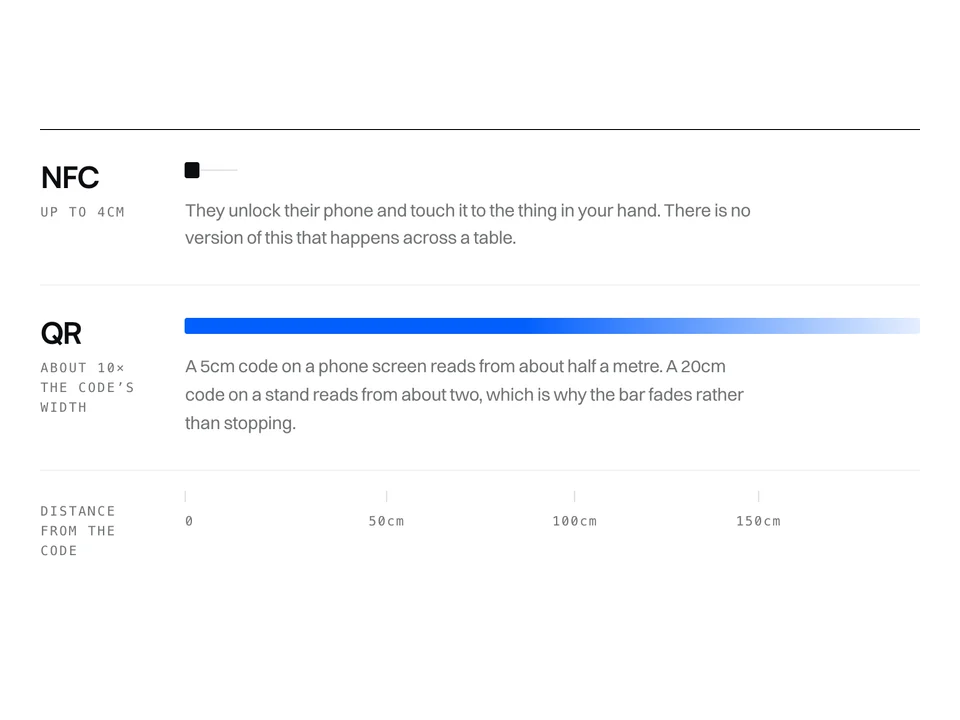
NFC vs QR for business cards
They fail in different places, and the distance between you decides which one matters.
Free forever. About a minute to build.
Nothing for the other person to install, and no card details to start.